
On the Legacy of Jerry Cohen

Jerry Cohen, who died earlier this month, did Thomas More one better. More may have been a “Man for All Seasons.” Jerry, as befits the title of his recent and compelling memoir, Eastward, Westward, was a Man for All Regions – more specifically, a man who more than any other united the East and West. As many have noted, he was founder, father, and doyenne of the study of Chinese law outside – and in many ways, inside -- China. As many have noted has well, he was very much more. Not least, he drew in, and supported, countless people who otherwise would not have been much involved in the rule of law and China. I was very fortunate to be one of them, and for that reason, so too have over a generation of my students at Princeton.
Jerry taught me profound lessons starting from the first time I became aware of him. Yet my first impression could not have been worse. I had just been involved in a human rights mission to Hong Kong just after its handover back to Chinese sovereignty. Not long after, the mainland government essentially overruled Hong Kong’s Court of Final Appeal concerning the right to abode under the new Basic Law designed to entrench the policy of “One Country, Two Systems.” This “[re]-interpretation” stoked fears that Hong Kong’s autonomy would be dead on arrival (rather than dead in 2020 with the National Security Law). Most human rights advocates and NGOs steadfastly supported the stand of the Hong Kong Judiciary. Yet Jerry argued that the Court of Final Appeal would have been wiser to issue a less bold ruling, the better to consolidate its position. At the time, I thought this Professor Cohen was one of those typica “China hands” who never missed the chance to err on the side of Beijing. I could not have been more wrong. One lesson I learned was that Professor Cohen was probably right and usually was. Another was that there was no more steadfast champion of the rule of law and human rights in China than Jerry Cohen.
Jerry taught these lessons in countless ways to multiple audiences. To specialists, his scholarship could not be anything other than essential since he more or less invented the study of modern Chinese law in the United States. Then there was his courageous championing of an array of Chinese lawyers, scholars, and activists, themselves courageous, who risked their careers and freedom in the cause of fulfilling the promise of a reconstructed Chinese legal system.
But for me, no less contribution was sustaining those concerned for the rule of law in general as it applied to the world’s largest state. General human rights advocates benefited from a lifelong crash course through NYU’s US-ALI programs, Jerry’s regular column in the South China Morning Post, and his unparalleled Winston Lord Roundtable sessions on China at the Council on Foreign Relations, an institution not known for prioritizing international human rights law (as witness its Henry Kissinger fellowships). Not for Jerry was the exclusivity speaking only to a closed group of specialists and Mandarin speakers. So long as one cared about promoting basic legal standards of equity and fairness, Jerry was instantly your mentor.
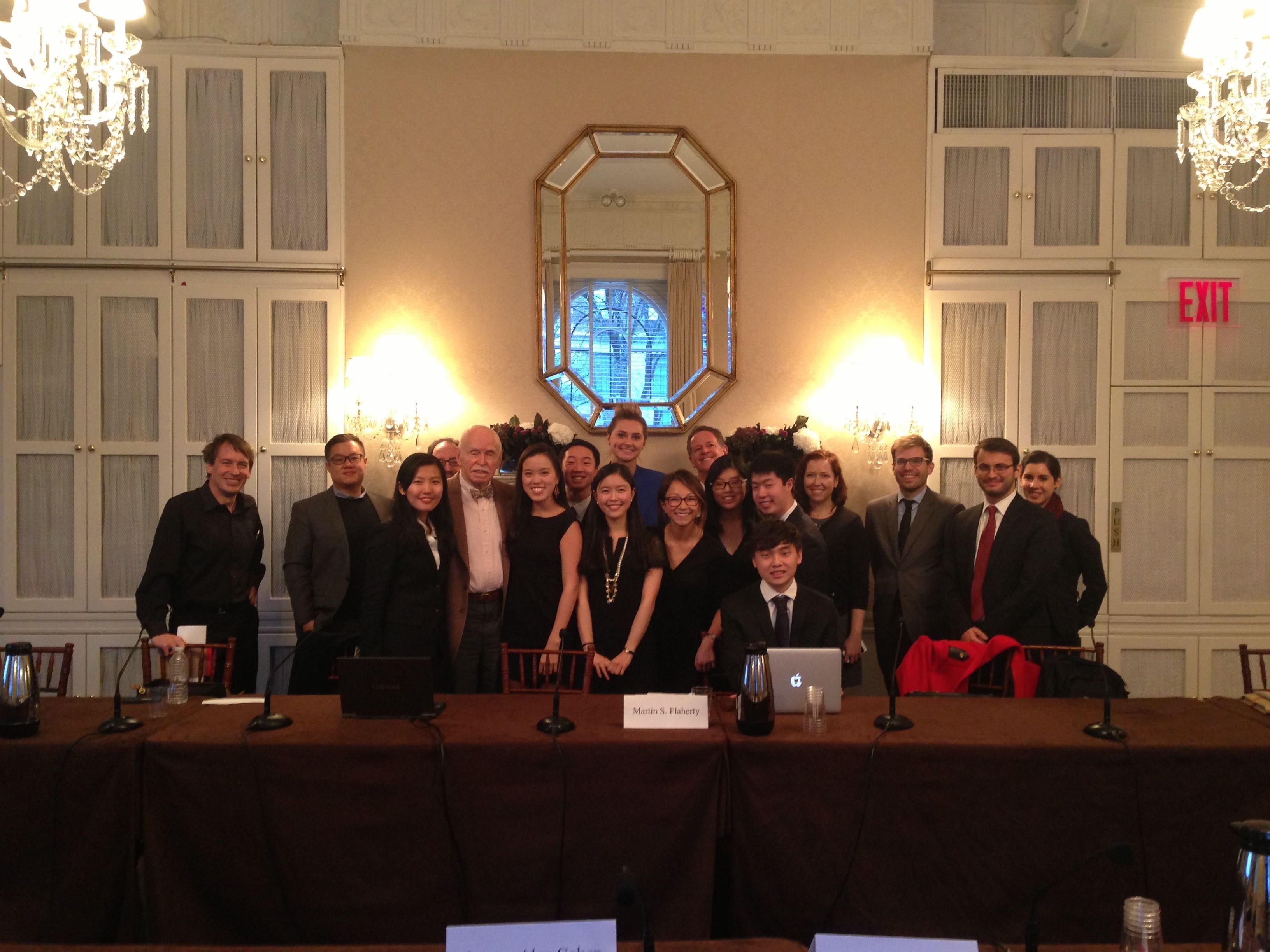
Among the innumerable mentees were my students. For over 20 years I’ve taught an ungraduated policy task force at Princeton’s School of Public and International Affairs devoted to the rule of law in China. For the first decade, the goal was promoting the idea in China; for the last ten years it has pivoted to defending the concepts from assaults by China. Either way, the project would culminate at the State Department and White House. But the real highlight of the course was our “dress rehearsal” at the Council on Foreign Relations in New York hosted by Jerry and China experts he assembled. There my students got a master class on all aspects of the topic. Among other things, they saw a man in his 80s, then 90s, going on 30. They also experienced Jerry’s rigorous courtliness and generosity. Most of all they appreciated how his disappointment with the regime’s turn away from law translated not into despair or cynicism. Rather, they saw that frustration turn into a renewed commitment to promoting fundamental fairness through law everywhere, including what has arguably become the most consequential country on the planet.
Given the countless persons Jerry has influenced in every region, it is a commitment that will live on. From all of us, Jerry, Xie Xie
.